

What happens if you eat pokeweed berries? In most cases, the main risk is poisoning that causes stomach and intestinal symptoms, but the outcome depends on the amount eaten, the person’s age, and how fast help is sought. This guide explains what pokeweed is, what symptoms can happen, how quickly they may start, and when the situation needs urgent medical attention.
Pokeweed, also called Phytolacca americana, is a wild plant known for its deep purple berries, reddish stems, and large leaves. It often grows along roadsides, fence lines, gardens, and disturbed ground. The problem is simple. The plant may look harmless, and the berries can resemble edible fruit from a distance. Yet pokeweed is not a casual “foraging mistake.” It is a toxic plant.
From a practical safety standpoint, this is the key message: do not eat pokeweed berries on purpose, do not use them in homemade remedies, and do not assume that a small amount is always safe. Some exposures stay mild. Others do not.
What is pokeweed, and why are the berries risky?
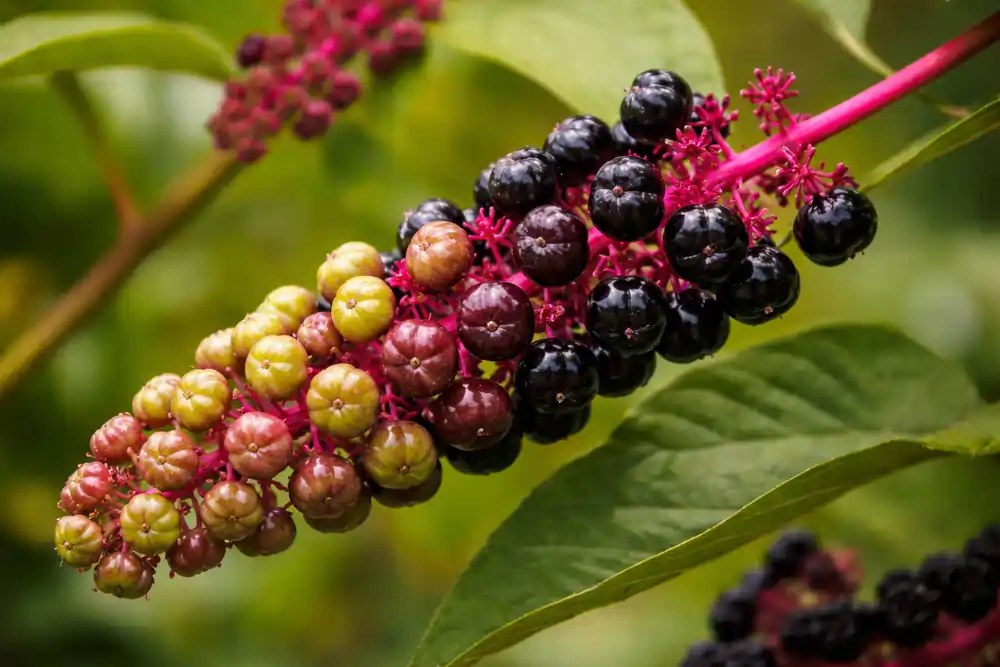
Pokeweed is a perennial plant native to parts of North America. Toxic compounds are present throughout the plant, including the root, stem, leaves, and berries. The roots are generally considered the most dangerous part. The berries contain less toxin than the roots, but that does not make them safe for people.
The plant contains compounds such as phytolaccatoxin and phytolaccigenin. These substances can irritate the digestive tract and may lead to more serious poisoning in larger exposures. Raw plant material is the main concern. Traditional folk use exists, but that history does not make home use reliable or safe.
In real-life cases, children are often exposed because the berries are shiny, purple, and easy to grab. Adults may be exposed after misidentifying the plant, using it in a home preparation, or assuming wild berries are edible.
| Plant part | Relative risk | Main concern |
|---|---|---|
| Root | Highest | Most toxic part; severe poisoning risk |
| Leaves and stems | High | Digestive irritation and poisoning risk |
| Berries | Moderate but still unsafe | Can cause nausea, vomiting, diarrhea, abdominal pain |
What happens if you eat pokeweed berries?
The most common outcome is gastrointestinal poisoning. That usually means nausea, vomiting, stomach cramps, abdominal pain, and diarrhea. In more serious cases, symptoms can include repeated vomiting, bloody diarrhea, weakness, low blood pressure, breathing problems, muscle spasms, or seizures.
Symptoms often start within several hours. A commonly cited window is within 6 hours after ingestion. However, the exact timing can vary.
Severity depends on several factors:
- How many berries were eaten
- Whether the berries were raw
- The age and body size of the person
- Whether other parts of the plant were also eaten
- How quickly medical advice is obtained
Children are at higher risk because even a smaller amount can matter more relative to body size. Also, children may not explain clearly what they ate or how much.
In plain terms, one or two berries may not always lead to severe poisoning, especially in older children or adults. But that is not a rule you can trust. Several berries can cause clear symptoms, and larger exposures can become dangerous.
How dangerous are pokeweed berries compared with the rest of the plant?
This is where people often get confused. You may read that the berries are “less poisonous” than the roots. That statement is true in a relative sense, but it is also misleading if taken as reassurance. Less toxic does not mean non-toxic.
The berries still contain harmful substances. Green berries are often considered more concerning than fully ripe dark berries, but ripe berries are not safe food either. Poisoning reports and poison center guidance treat the berries as toxic.
So the correct conclusion is this: the berries are not the worst part of pokeweed, but they are still a bad idea to eat.
| Question | Practical answer |
|---|---|
| Are pokeweed berries edible? | No. They should not be eaten raw or used casually. |
| Are they less toxic than the root? | Yes, but they can still cause poisoning. |
| Can one person react differently from another? | Yes. Age, dose, and health status matter. |
| Should you wait for symptoms? | No. Get poison advice early. |
What symptoms should you watch for first?
The first signs are usually digestive. These include:
- Nausea
- Vomiting
- Cramping
- Abdominal pain
- Diarrhea
If symptoms worsen, the red flags become more serious:
- Repeated vomiting
- Severe diarrhea
- Blood in vomit or stool
- Weakness or unusual sleepiness
- Trouble breathing
- Confusion
- Seizures
- Collapse or poor responsiveness
From an emergency perspective, trouble breathing, seizures, loss of consciousness, or severe dehydration are the biggest warning signs.
What should you do right away after eating pokeweed berries?
Act early. Do not wait for the situation to “declare itself.”
Immediate steps
- Remove any remaining berries from the mouth.
- Rinse the mouth gently with water.
- Do not force vomiting unless a poison expert or clinician tells you to do so.
- Keep a sample or photo of the plant if you can do it safely.
- Contact your local poison center or emergency service right away for advice.
If the person has breathing trouble, a seizure, collapses, or cannot be awakened, call emergency services immediately.
Quick checklist
- Identify the plant if possible
- Estimate how many berries were eaten
- Note the time of exposure
- Watch for vomiting, diarrhea, or drowsiness
- Call poison help without delay
When is pokeweed berry ingestion a medical emergency?
It is urgent if a child ate an unknown amount, if more than a small amount was eaten, or if symptoms have already started. It is an emergency if there is persistent vomiting, severe diarrhea, blood in stool or vomit, breathing difficulty, seizure activity, or reduced alertness.
There is also a simple common-sense rule. If you are not sure whether it was pokeweed or a similar-looking berry, treat the event seriously until a poison expert says otherwise.
This matters because berry mix-ups happen. Pokeberries can be mistaken for grapes or other dark berries by children and by adults who are unfamiliar with the plant.
How often do plant poisonings happen?
Plant exposures are not rare. Poison center data show that plants account for a measurable share of poisoning cases. On the Poison Control public dashboard, plants represent a small but real percentage of poison center categories. That may sound modest, but in practice it still means many people each year call for help after a plant exposure.
That pattern fits what clinicians see. Many cases stay mild, especially when only a small amount is involved. But a small percentage become more serious because the plant was misidentified, the amount was larger, or the patient was very young.
That is why prompt poison guidance matters more than internet guesswork.
Can cooked pokeweed ever be safe?
You may come across references to “poke sallet” or other traditional preparations. This topic needs caution. Some traditional methods involve repeated boiling and discarding the water. Even so, that is not a safe home project for most readers.
Medical and poison references do not recommend casual use because preparation errors can lead to poisoning, and the roots should never be eaten. For a beginner audience, the safest advice is straightforward: do not experiment with pokeweed.
As someone writing for general readers rather than foraging experts, I would not frame pokeweed as a “careful if you know how” food. The downside is too real, and the upside is unnecessary.
How can you tell pokeweed berries apart from safe berries?
Pokeweed usually has drooping clusters of dark purple berries on bright reddish or magenta stems. The stems are one of the best clues. The plant itself is often tall, smooth-stemmed, and strikingly colored.
That said, visual ID from memory is risky. Many berry accidents happen because someone relied on a quick guess. Children are even more likely to confuse pokeberries with grapes or edible garden fruit.
If you need a practical prevention rule, use this one: never eat wild berries unless identification is certain from a reliable local expert source.
FAQ
Are pokeweed berries poisonous?
Yes. The berries are toxic and can cause poisoning, especially if several are eaten.
How long after eating pokeweed berries do symptoms start?
Symptoms often begin within 6 hours, though timing can vary.
What are the first symptoms?
Nausea, vomiting, stomach pain, cramps, and diarrhea are the most common early signs.
Are children at higher risk?
Yes. Children are at higher risk because body size is smaller and dose matters more.
Should you make someone vomit?
No. Do not induce vomiting unless a poison expert or clinician tells you to.
Are ripe dark berries safer than green ones?
Not safe. Even if toxicity varies, ripe berries should still not be eaten.
Is pokeweed poisoning always severe?
No. Some cases are mild, but serious poisoning can happen, so every exposure deserves prompt advice.
Glossary
Phytolacca americana — The scientific name for American pokeweed.
Pokeweed — A toxic wild plant with reddish stems and dark purple berries.
Pokeberries — The berries produced by pokeweed.
Phytolaccatoxin — One of the toxic compounds associated with pokeweed.
Phytolaccigenin — Another toxic compound found in pokeweed.
Gastroenteritis — Inflammation of the stomach and intestines, often causing vomiting and diarrhea.
Poison center — A service that gives urgent expert advice after a poisoning exposure.
Supportive care — Medical care that treats symptoms and body function rather than using a specific antidote.
Conclusion
If you eat pokeweed berries, the most likely problem is poisoning with stomach and intestinal symptoms, but larger exposures can become serious. Treat any pokeweed ingestion with caution and get poison advice early instead of waiting.
Sources
MedlinePlus, pokeweed poisoning overview, symptoms, timing, and emergency guidance — medlineplus.gov/ency/article/002874.htm
Poison Control, pokeberries and grapes look-alike, practical exposure guidance — poison.org/articles/pokeberries-and-grapes-look-alike
Poison Control homepage, poison help access and poison category dashboard including plants — poison.org
Merck Manual Professional, moderately poisonous plants and pokeweed effects — merckmanuals.com/professional/multimedia/table/moderately-poisonous-plants
Merck Manual Professional, plant poisoning and general treatment principles — merckmanuals.com/professional/injuries-poisoning/poisoning/plant-poisoning
University of California IPM, pokeweed toxicity and severe digestive tract irritation — ipm.ucanr.edu/home-and-landscape/pokeweed/
Penn State Extension, common pokeweed identification and toxicity warning — extension.psu.edu/common-pokeweed-identification-and-management
Oregon State University, pokeweed risk summary for people, pets, and livestock — solvepestproblems.oregonstate.edu/weeds/pokeweed
University of Illinois Extension, caution on berries and improper preparation — extension.illinois.edu/blogs/good-growing/2024-07-12-duality-american-pokeweed
